






Introduction
The first step a dietician takes while framing your personalised meal plan is to find out your daily calorie requirement. Basically, it is the amount of calories your body needs to function and maintain weight. But how about if you could find that out for yourself right at your house?
This blog comes with the formula to help you calculate it at your home. Once you do, you can eat food that fulfils your daily calorie requirement for weight loss or gain- whatever you like. However, it depends on your age, gender and the amount of physical activity you do in a day. It is very specific and unique for everyone. Find yours today to make wiser eating choices!
Understanding Calorie Needs by Age, Gender & Activity
To get into your daily calorie requirement, you must consider the factors like:
The three primary factors determining your TDEE are:
Your body needs a specific amount of energy and that is measured in calories. This energy is used for basic functions and fuels your body for daily activities. This number, known as your Total Daily Energy Expenditure (TDEE), is highly specific and far from a fixed value for a person.
1. Age:
You may find your calorie needs declining as you age. Usually, this is due to your slowing metabolism and hence reduction in muscle mass. It is more metabolically demanding than fat in your body.
2. Gender:
If you are a male, then you’ll have higher caloric requirements than a woman. Higher calories needed per day for males is due to a larger average body size and a higher proportion of muscle tissue.
3. Activity Level:
This is the most variable factor when talking about daily calorie requirements. A person with more of a desk job will need fewer calories than someone who performs strenuous activity daily.
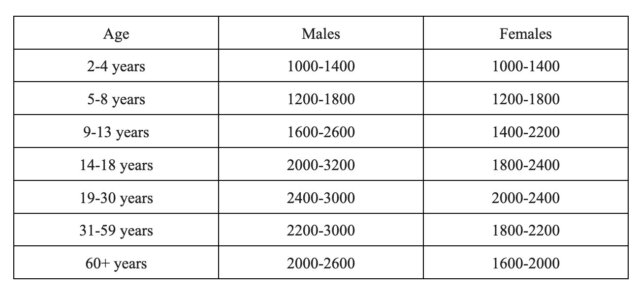
Calorie Chart for Men & Women
Estimated calories needed per day for male
As per your age and lifestyle, males should stick to this calorie chart.
Age (years) | Sedentary lifestyle | Moderately Active lifestyle | Active lifestyle |
| 19-25 | 2,400 | 2,600-2,800 | 3000 |
| 26-45 | 2,200-2,400 | 2,400-2,600 | 2,800-3,000 |
| 46-65 | 2,000-2,200 | 2,200-2,400 | 2,600-2,800 |
| 66+ | 2,000 | 2,200 | 2,400-2,600 |
Estimated daily calorie requirement chart for women:
However, the chart does not include pregnant or lactating women as they have higher caloric needs.
Age (years) | Sedentary lifestyle | Moderately Active lifestyle | Active lifestyle |
| 19-25 | 2,000 | 2,200 | 2400 |
| 26-50 | 1,800 | 2,000 | 2200 |
| 51+ | 1,600 | 1,800 | 2,000-2,200 |
How to Calculate Your Daily Calorie Requirement in 2 steps?
Age and gender are primary inputs to the BMR formula. The number of calories your body burns while resting for vital functions is what BMR is. You can find out your BMR using this formula!
BMR, also called Basal Metabolic Rate, is a vital aspect to find out your daily calorie requirement. Furthermore, men typically have a higher metabolic rate than women. It is due to greater muscle mass in males. Therefore, this factor, BMR, usually decreases as you age.
Step one: calculate Basal metabolic rate
You can follow the common Mifflin-St Jeor Equation to find out your BMR for daily caloric needs:
• For Men:
BMR = (10 x weight in kg) + (6.25 x height in cm) – (5 x {age in years}) + 5
• For Women:
BMR = (10 x weight in kg) + (6.25 x height in cm) – (5 x age in years) – 161
Step 2: Apply the activity factor (TDEE) for daily calorie requirement:
Activity level | Factor | Description |
| Sedentary | 1.2 | Little to no exercise |
| Lightly active | 1.375 | Light exercise or sport |
| Moderately active | 1.55 | Moderate exercise or sport |
| Very active | 1.725 | Hard exercise or sport |
| Extra active | 1.9 | Very hard daily exercise/ workout/ training or physically demanding job. |
This can help you understand your calories required per day and may pave way for better nutrition.
Calorie Deficit for Weight Loss:
A deficit of calories is created when you burn more calories than you consume- enabling your body to burn fat for fuel. It is good for weight loss and can be created by doing these things together:
- Workout or exercise
- Low calorie diet
- Avoiding high fat foods including sugar
Daily calorie requirement to create a deficit:
For a safe weight loss, your safe calorie deficit should be 250-500 lower than the calories required per day or your maintenance calories. Moreover, you can follow the chart as per your activity level:
- Sedentary lifestyle: 1700-2000 calories
- Active lifestyle: 1900-2200 calories
Calorie Surplus for Weight Gain:
On the other hand, when you have a higher calorie intake as compared to your burning rate, you put on weight. It leads to weight gain by creating a surplus of calories for your body to use. However, it is vital that your weight gain comes from healthy foods that meet your higher daily calorie requirement.
When you eat nutritious food that fuels your body with calories, you can achieve a surplus. Moreover, unhealthy foods that have empty calories may contribute to your surplus with zero benefits. Only opt for healthier ways for the same.
Daily calorie requirement to create a surplus:
- Sedentary lifestyle: 2000-2400 calories
- Active lifestyle: 2200-2600 calories
Conclusion
To sum up, every person is unique and so is their age, gender and activity level. Based on these factors, you can find out your exact daily calorie requirement. It is vital to know how many calories you need to have a stable and healthy weight. When you find it out, eating to manage your weight becomes easier. The amount of calories you need also determines if there would be a deficit or a surplus in your body.
Moreover, you can visit a dietician to discuss your daily calorie requirement. If you want to manage your weight or need help setting some goals, a professional is always there.
Frequently Asked Questions
Question: How many calories should I eat daily?
Question: What factors affect my calorie needs?
Question: How do I calculate calorie intake for weight loss?
Question: Are all calories equal?